
For years, progress in drone technology has been measured by autonomy. The scale of open-ocean search is easy to underestimate. The 52-day surface search for Malaysia Airlines Flight 370 covered several million square kilometers, followed by a high-resolution underwater search of more than 120,000 square kilometers of seafloor, without locating the aircraft.1 Challenges at this scale helped advance autonomous flight, navigation, sensing and mission planning. But independence may not be the most important frontier. Human Machine Collaboration, or HMC, asks how human knowledge, judgment and responsibility can combine with machine sensing, speed and computation to create a stronger team.
HMC Meets Search and Rescue
Consider a person falling from a moving vessel. At 12 knots, the vessel covers more than six meters every second and roughly 370 meters in one minute. Meanwhile, the victim is moving with currents, pushing the person through the water. The last known location is therefore only a starting datum, last known position or starting search point. As time passes, uncertainty around that starting search point grows and the search area expands.234
A rescue mission also contains information a coordinate cannot capture. Witnesses may remember the point of entry, clothing, flotation or swimming ability. The captain understands the vessel and local conditions. First responders bring experience with currents, hazards and how people behave under stress. These accounts may disagree, but the disagreement itself can reveal where uncertainty remains.
The human contribution is not simply another sensor. Humans know things the machines may never have observed, especially what happened before the drones arrived, what a witness meant, and what a responder recognizes from experience. Machines contribute something different: distributed sensing, precise geolocation, persistent coverage and continuous computation. This symbiotic relationship creates a shared mental model and need for a collaboration layer between human judgment and machine capability. We believe that layer is where HMC becomes operational, and where a viable new product category may emerge.
| Humans | Context, prior knowledge, judgment and responsibility | Limited by position, visibility, workload and incomplete information |
|---|---|---|
| Autonomous Drones | Distributed sensing, geolocation, persistence and computation | Limited by training, communications, payload and context |
| Humans + Drones (HMC) | Shared mental model combines context with distributed sensing | Each side can identify and compensate for the other's uncertainty |
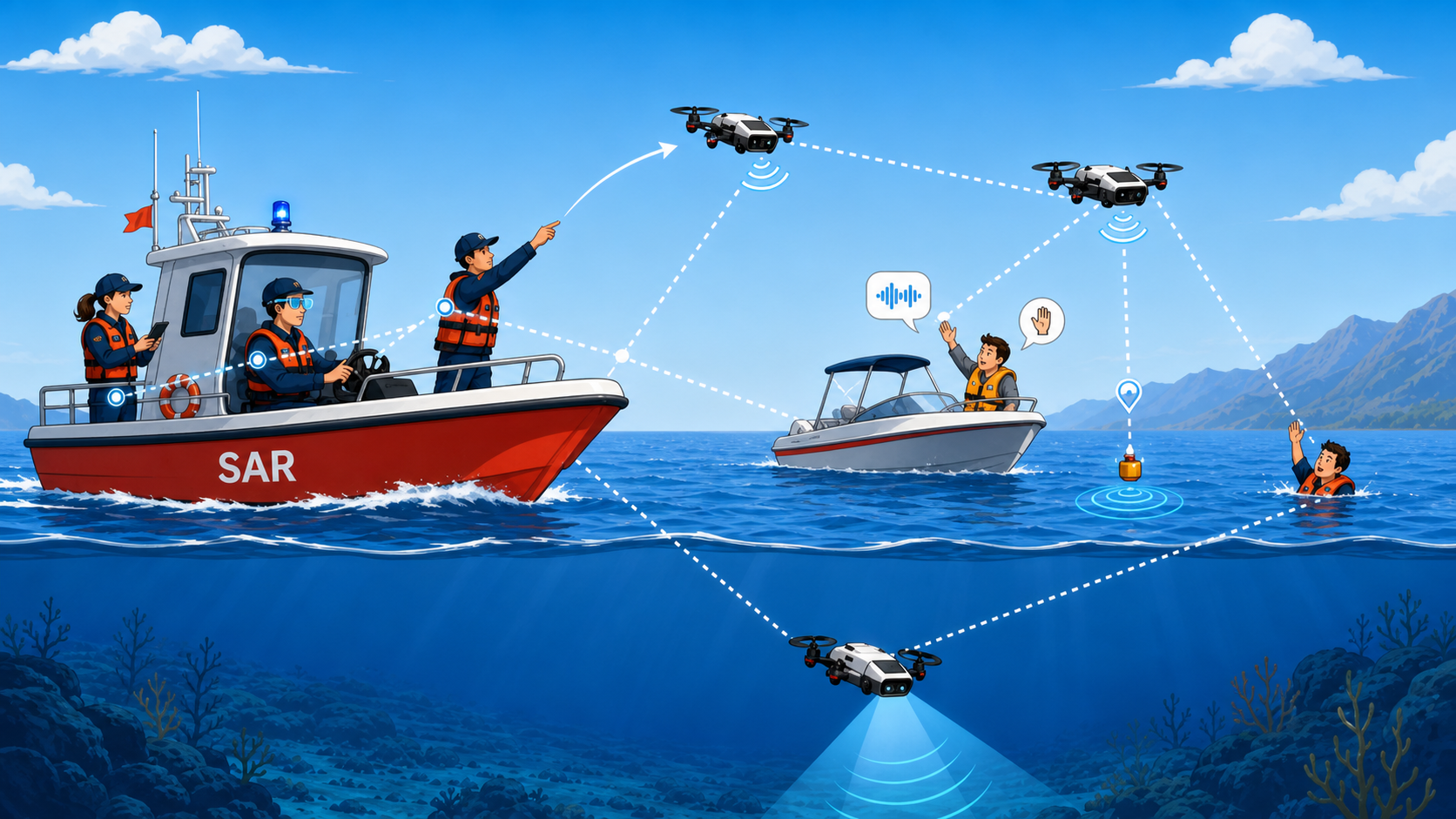
Wide Area Search
The U.S. Coast Guard is evaluating short-, medium- and long-range unmanned aircraft for maritime surveillance and search and rescue, and in 2025 tested unmanned aircraft and surface systems in person-in-the-water recovery scenarios.56 Sensing capability is also improving as better visible and infrared detectors combine with more onboard computation.78 Amphibious systems such as the SubUAS Naviator demonstrate that a platform can transition between aerial and submerged operation, while related research such as AquaMAV and Loon Copter shows a broader class of hybrid air-water systems.9101112
A swarm extends the idea further. Multiple drones can separate across the search area, share detections and coordinate coverage. In an HMC sense, the humans also become part of a broader distributed sensing aperture. Machine sensors contribute observations across space and sensing modalities, while witnesses, the captain and first responders contribute context, memory and experience. Together they can form a "synthetic aperture of understanding," an analogy to distributed sensing in which the combined picture resolves more than either side can alone.13
Existing human-swarm systems have already shown that one person can supervise or coordinate many autonomous platforms, and search-and-rescue research is beginning to apply swarm autonomy directly to locating victims. The HMC question here is different: the human is not simply the operator above the swarm. Witnesses, first responders, the captain and eventually the victim become active participants whose knowledge and actions can update the shared mental model and change what the autonomous network does next. From separate capabilities to one collaborative mission picture.
How HMC Works in This Scenario
Imagine three amphibious drones connected to a collaboration layer. Instead of receiving only a location and following a fixed route, the layer maintains a shared mental model across the rescue team, witnesses and autonomous systems. It represents what each participant knows, where accounts agree or conflict, what the machines are sensing and what information is still missing.
The system can identify who is best positioned to resolve an uncertainty and ask a targeted question or provide a context-aware recommendation. If disagreement about the point of entry is driving the search, a question to the right witness can immediately re-weight the probability area and re-task the swarm. Human knowledge is combined with vessel movement, currents, wind, elapsed time and sensor readings to create a dynamic, victim-customized search package that changes as new evidence arrives.
Use Case: The Drone as an HMC Interface
The scenario assumes an integrated collaboration interface that does not yet exist in this form. Today, drone interfaces are typically designed to operate aircraft. The HMC interface is designed to help a human-machine team maintain the same operational picture and act on it together.
Upstream, humans express what they know naturally. A captain can point, speak or sketch rather than program waypoints. A witness can identify the area where they last saw the victim. The collaboration layer translates speech, gesture and observations into search priorities, probability weights or re-tasking. Downstream, machine sensing returns in forms built for human perception, such as a HUD overlay (information displayed directly in the captain's field of view), spatial audio or a simple confidence cue, instead of a wall of separate sensor feeds.
Between those directions sits collaboration intelligence. It keeps track of each participant's role, situational knowledge and likely information needs, highlights conflicts, and adapts when communications, sensors or team conditions change. These ideas build on established human-machine teaming concepts such as shared mental models, context-aware support, multi-channel observations and resilient teamwork, but apply them to a civilian rescue network rather than a single operator controlling software.
Once the victim is located, the collaboration problem changes again. Voice, gestures, movement and responsiveness become additional information channels. The drones can maintain contact and relay those observations while the rescue vessel approaches. The machine does not receive medical authority. Its role is to reduce the information and communication gap between detection and physical intervention.
There is precedent for individual pieces of this interface. Systems such as Anduril's Lattice demonstrate large-scale autonomous-system coordination, while the TAK ecosystem demonstrates shared operational information across large numbers of users.2526 The HMC layer extends the interface beyond operating machines toward helping the witness, captain, responder, victim and autonomous systems contribute to one shared mission model.
The Science of Collaboration
Making this possible requires more than adding artificial intelligence to a drone. First, the team needs a shared mental model: what the system knows, what each participant has contributed, what the humans are trying to accomplish and where situational awareness differs. Second, the system must communicate uncertainty rather than only conclusions, showing confidence, conflicting accounts and the information gaps that matter most.
Third, the collaboration layer must understand its own limitations and remain adaptable when visibility falls, communications are lost, a sensor becomes unreliable or new human information changes the search model. Fourth, autonomy must remain flexible. The swarm can adjust search routes or redistribute coverage, while the rescue commander retains authority over safety, priorities and intervention. Finally, important decisions must remain understandable so people know why the system changed course or requested human input.
These requirements are grounded in a long line of human-machine research. Licklider framed the ambition as man-computer symbiosis.27 Later work emphasized observable and directable machine teammates,28 calibrated trust rather than maximal trust,29 and the fact that human-AI collaboration is not automatically better unless the capabilities genuinely complement one another.30 Human differences also matter, meaning the same interface or level of autonomy may not work equally well for every operator.31
The Market: Capability Is Compounding, and Capital Knows It
The market is moving in the same direction as technology. The global civil drone market is estimated at roughly $44 billion in 2026 and projected to reach about $83 billion by 2035.15 Ground-control markets, one of the adjacent layers where humans interact with autonomous systems, are projected to grow at more than 22 percent annually.17 Investment data also shows capital concentrating into fewer, larger robotics and drone deals.14
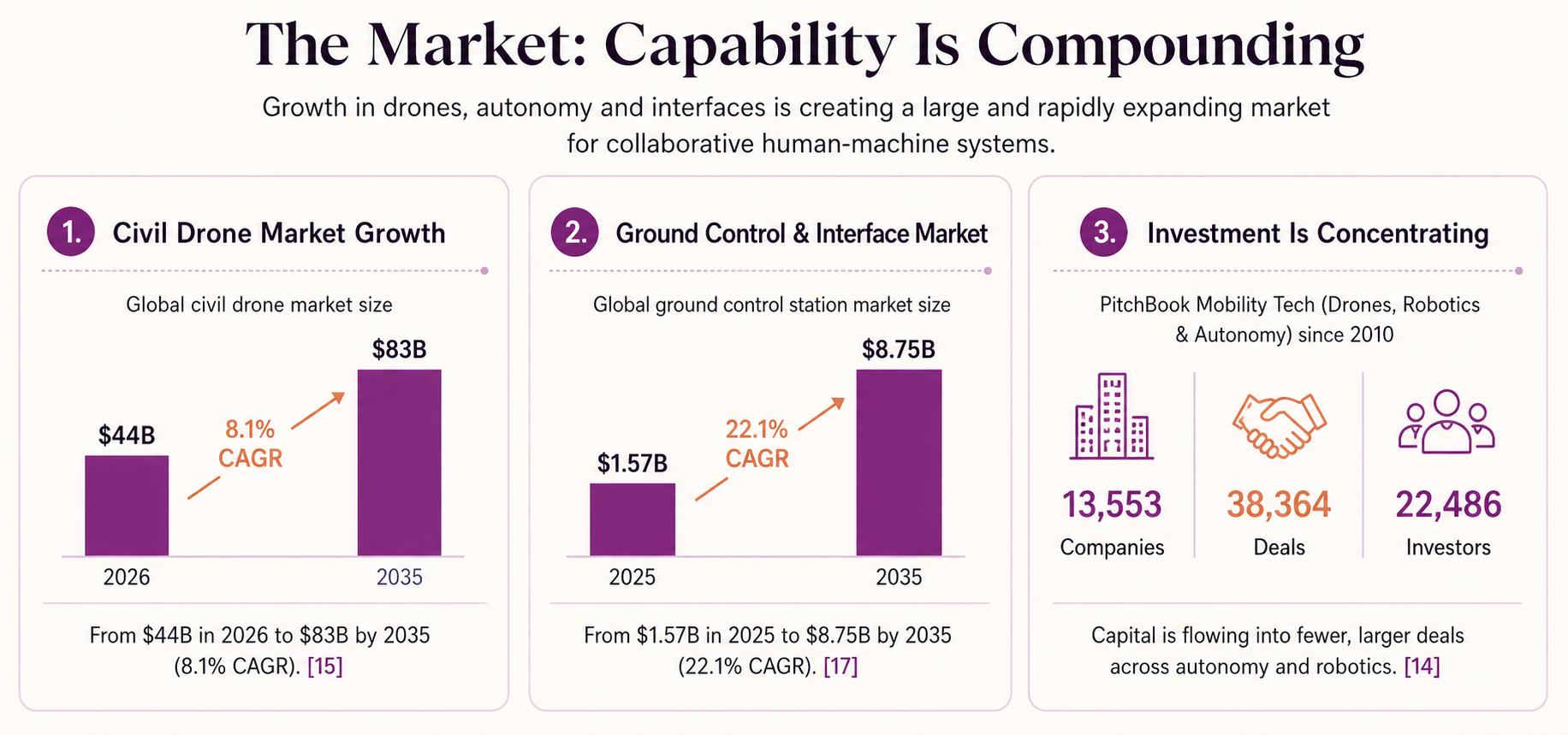
Put the layers side by side and the opportunity becomes clearer. The airframe layer is increasingly mature and concentrated, while autonomy and software are attracting larger amounts of capital. The emerging white space is collaboration, where human judgment and machine sensing meet. Today's ground stations, tablets and tactical maps were largely designed to operate autonomous systems, not to help humans and machines understand and adapt to one another. That gap is the opportunity.
Conclusion: From Autonomous Platforms to Collaborative Systems
The person-overboard scenario is one example of a much broader HMC opportunity. Humans bring context, judgment and experience, while autonomous systems bring sensing, scale and continuous computation. The collaboration layer connects those strengths into a shared understanding of the mission and helps the team determine who is best positioned to act next.
The same principles can extend to wildfires, disaster response, infrastructure inspection and humanitarian logistics. Across these missions, the central question is not whether the human or machine should control the mission. It is how their different forms of intelligence can work together. Autonomy makes individual machines more capable. Human Machine Collaboration can make the entire system more capable.
References
Full reference set preserved from the long-form paper.
- 1.Australian Transport Safety Bureau. The Operational Search for MH370. Final Report, External Aviation Investigation AE-2014-054, 3 October 2017.
- 2.International Maritime Organization and International Civil Aviation Organization. International Aeronautical and Maritime Search and Rescue (IAMSAR) Manual, Volume II: Mission Co-ordination.
- 3.U.S. Coast Guard. The U.S. Coast Guard Addendum to the United States National Search and Rescue Supplement to the IAMSAR Manual, COMDTINST 16130.2H, 17 July 2025.
- 4.Allen, A. A., and J. V. Plourde. Review of Leeway: Field Experiments and Implementation. U.S. Coast Guard Research and Development Center, Report CG-D-08-99, 1999.
- 5.U.S. Coast Guard. Robotics and Autonomous Systems: Air.
- 6.U.S. Coast Guard Research and Development Center. Research and Development Center evaluates unmanned search and rescue capabilities, 30 May 2025.
- 7.Hendy, Barry. Hendy's Law: pixels per dollar based on Australian recommended retail price of Kodak digital cameras. Trend analysis originally developed at Kodak Australia.
- 8.Rogalski, Antoni. "Infrared detectors: status and trends." Progress in Quantum Electronics 27, no. 2-3 (2003): 59-210.
- 9.Rutgers Center for Advanced Infrastructure and Transportation. Rutgers Naviator UAS conducts first combination aerial-and-underwater bridge inspection.
- 10.Maia, Marco M., Parth Soni, and Francisco J. Diez. "Demonstration of an Aerial and Submersible Vehicle Capable of Flight and Underwater Navigation with Seamless Air-Water Transition," 2015.
- 11.Imperial College London. Aquatic Micro Air Vehicle (AquaMAV) research.
- 12.Alzu'bi, Hamzeh, Iyad Mansour, and Osamah Rawashdeh. "Loon Copter: Implementation of a hybrid unmanned aquatic-aerial quadcopter with active buoyancy control." Journal of Field Robotics 35, no. 5 (2018): 764-778.
- 13.Skolnik, Merrill I., ed. Radar Handbook. 3rd ed. New York: McGraw-Hill, 2008.
- 14.PitchBook Data, Inc. Robotics and Drones Vertical - Companies & Deals Screener: 13,553 companies; venture deal counts, capital raised, and median valuations, 2017-2026. Accessed August 21, 2026.
- 15.Drone Industry Insights. The $83 Billion Drone Market by 2035. May 2026.
- 16.Grand View Research. Military Drone Market Size, Share & Trends Analysis Report. June 2026.
- 17.Fortune Business Insights. Unmanned Aerial Vehicle (UAV) Ground Control Stations (GCS) Market. August 2026.
- 18.National Security and Defense Council of Ukraine. Results of 2025: FPV drone production capacity exceeds 8 million units per year. January 23, 2026.
- 19.The White House. Executive Order 14307, Unleashing American Drone Dominance. June 6, 2025.
- 20.Secretary of Defense. Unleashing U.S. Military Drone Dominance. Memorandum, July 10, 2025.
- 21.TechCrunch. Anduril raises $5B, doubles valuation to $61B, May 13, 2026; Anduril reportedly in talks to raise at $100B valuation, July 24, 2026.
- 22.TechCrunch. Defense startup Shield AI lands $12.7B valuation after U.S. Air Force deal. March 26, 2026.
- 23.Skydio. Series F announcement ($110M at $4.4B valuation). April 2026.
- 24.Berg Insight. Connected Commercial Drones (DJI at approximately 70% global commercial market share). April 2025.
- 25.Anduril Industries. Lattice for Mission Autonomy. See also DefenseScoop, Army selects Anduril Lattice for IBCS-M counter-UAS fire control, November 11, 2025.
- 26.Breaking Defense. Evolution and future of the Tactical Assault Kit for soldiers and special operators (over 500,000 users). November 2025.
- 27.Licklider, J. C. R. "Man-Computer Symbiosis." IRE Transactions on Human Factors in Electronics, HFE-1 (1960): 4-11.
- 28.Klein, Gary, David D. Woods, Jeffrey M. Bradshaw, Robert R. Hoffman, and Paul J. Feltovich. "Ten Challenges for Making Automation a Team Player in Joint Human-Agent Activity." IEEE Intelligent Systems 19, no. 6 (2004): 91-95.
- 29.Lee, John D., and Katrina A. See. "Trust in Automation: Designing for Appropriate Reliance." Human Factors 46, no. 1 (2004): 50-80.
- 30.Vaccaro, Michelle, Abdullah Almaatouq, and Thomas Malone. "When Combinations of Humans and AI Are Useful: A Systematic Review and Meta-Analysis." Nature Human Behaviour 8 (2024): 2293-2303.
- 31.O'Neill, Thomas, Nathan McNeese, Amy Barron, and Beau Schelble. "Human-Autonomy Teaming: A Review and Analysis of the Empirical Literature." Human Factors 64, no. 5 (2022): 904-938.